


Vintage Vibes: History of the Gibson J-50
Gibson’s Dark Horse - The guitar manufacturer’s best kept secret, the J-50, isn’t dark at all–it’s blonde.
When you talk about Gibson acoustics, it’s rare to begin with any other model than the J-45. The slope-shoulder dreadnought is Gibson’s most famous, adored for its versatility, with warm bass, excellent projection and ease of play, and a deep sunburst finish that’s become an iconic visage associated with 20th-century music ranging from folk to blues, country, and back. But in its shadow is an equally important model that can–and should– be mentioned in the very same breath: the Gibson J-50.
Played by a host of acoustic luminaries like Jorma Kaukonen, John Hiatt, Brad Paisley, and Bob Dylan, the J-50 is every bit as versatile as the J-45, and it’s reputation as an insider secret makes vintage models a collector’s dream. Producing the exact same legendary tone that filled popular American recordings for decades in the J-45, the J-50 is essentially the exact same guitar. And yet it’s not, which is perhaps its best quality of all.
Call 1-773-525-7773 to discuss this amazing piece of Gibson Guitars history.


The Development of the J-50
Essentially a blonde or natural finish J-45, Gibson first introduced the J-50 in 1942. Wartime shortages forced a hold on production shortly after, but the J-50 became an official part of Gibson’s core product line as early as 1947. Its specs would always largely mirror that of the J-45. If the J-45 changed, so did the J-50. But there are a few important historical differences that do set the lesser known blonde apart.
In 1950, Gibson added a triple-bound top to the J-50, further differentiating it from the J-45.
Five years later, Gibson altered the bracing in the lower bout and introduced a 20th fret as well as a larger pickguard with a point toward the upper bout, replacing the conventional teardrop. As the 1950s began to wane and production of the J-50 entered a new decade, Gibson introduced adjustable saddles to the bridge, which became standard in 1961. In 1963, Gibson replaced the older celluloid pickguard with a thicker, injection-molded styrene version. Gibson also briefly transitioned to a plastic bridge, which they would abandon for rosewood a year later. In 1968, Gibson added a white, screw-on “GIbson” logo pickguard, and in 1969 introduced a new square-shoulder body shape, but both changes were short-lived and scrapped shortly thereafter.
Fourteen years after that, in 1982, Gibson officially removed the J-50 from their core models but continues to produce it periodically to this day.
Where is the J-50 now?

The J-50 has been available in the Japanese market for years, and we’re finally bringing those new production models home in the Gibson Montana Limited 1959 J-50 Antique Natural and Gibson Montana J-50 Thermally Aged Sitka Spruce Antique Natural Limited Edition, available for the first time in the United States and manufactured exclusively for Chicago Music Exchange.
The Gibson Montana Limited 1959 J-50 Antique Natural blends modern Gibson technology like the thermally aged Sitka spruce top with historic specs like hot hide glue construction on the top and back, traditional hand-scalloped X-bracing, bone nut and saddle, legend fret wire and a double antique thin finish to create an instrument that transcends time. It looks and feels just like a vintage gem but sings with the kind of tone and response that can only come with decades of innovation.
The Gibson Montana J-50 Thermally Aged Sitka Spruce Antique Natural Limited Edition compliments the same modern Gibson thermally aged Sitka spruce top with specs pulled from the 1966 model like hot hide glue construction on the top and back, traditional hand-scalloped X-bracing, narrow 1.575”-width bone nut, large legend fret wire, and a VOS finish to create yet another distinctive and timeless tribute with the look and feel of a true ‘66 model and the reliability and durable construction of today’s Gibson Montana.
Call, click, or stop in to discover a piece of history that’s truly unforgettable–even if history doesn’t always think to remember it. They’re no J-45 and we couldn’t be happier about it.
SHOP VINTAGE GIBSON ACOUSTICS
Related Posts
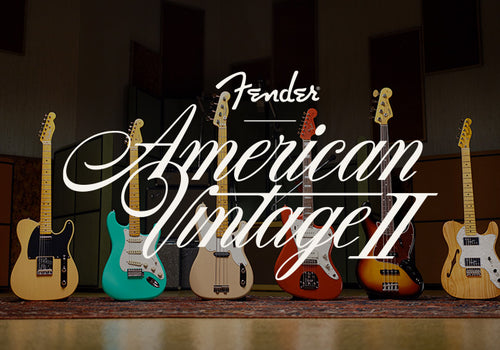
Fender American Vintage II
Inspired by the essence of authentic craftsmanship from the Golden Age of electric guitar design, the new Fender American Vintage II series draws on over 75 years of innovation to...
Read more
Boutique Guitar Showcase | 2023 - TC
Mark your calendars! Just as we did in 2020-2022, Chicago Music Exchange will proudly host the Boutique Guitar Showcase enTour 2023! Admirers of boutique guitar craftsmanship and fine lutherie, alike,...
Read more
Antelope Audio Interface Free Plugin Offer
As part of Chicago Music Exchange's ongoing partnership with Antelope Audio, we’ve partnered up to offer CME’s six-string devotees three FREE quintessential guitar effects plugins—including the Memory Cat Brigade Bucket Brigade Delay,...
Read more