


- Brand New
UDO OMN-1 Synth Control Expansion Module for DMNO ON
UDO OMN-1 Synth Control Expansion Module for DMNO ON

Available for Pre-Order!
-
This Item Ships Free!
-
Return Policy
Description
Description
DMNO ON is the full-featured 8-voice, 2-part multi-timbral DMNO synthesizer in a compact desktop format. Built around two independent analog-hybrid synth engines, it retains DMNO’s highly flexible signal architecture, with each engine featuring our new Dynamic Multi-Core Stereo VCF. Eight creative Play Modes unlock dynamic interactions between the two timbres at the touch of a single control, while its flexible analog and digital audio connectivity make it a truly expansive and immediate sound design sandbox.
A new approach to analog. DMNO merges UDO’s championed hybrid sound with a cutting-edge, playful, and performative control architecture. Eight-voice polyphony, dual hybrid binaural synth-engines, and the entirely new per-voice analog Dynamic Multi-Core Stereo Filter system deliver a deep sonic palette, from extreme, overdriven textural scenes to rich, organic analog warmth.
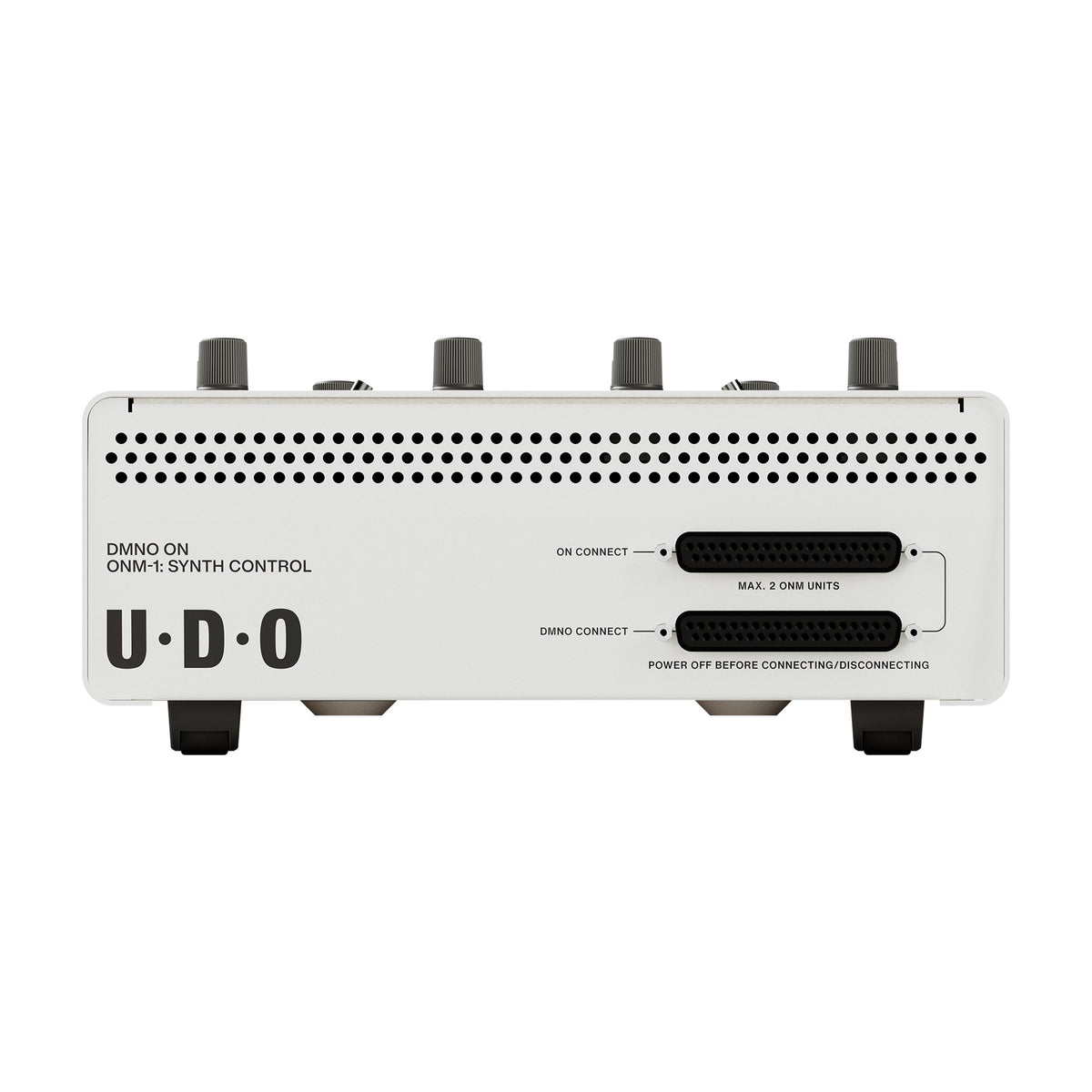
The ON system introduces expandable control. The base unit features a streamlined single control-set while retaining the full 8 voice bi-timbral synthesis engine. Add an ONM-1 Synth Control to recreate the dual DMNO layout, and/or an ONM-2 Effects Control for hands-on playability of the onboard effects engines. With a suite of ONM units planned, the ON ecosystem will grow to allow players to build and shape the instrument around their own workflow.
At the heart of DMNO is the Play Modes system. Instantly reconfigure the internal architecture at the touch of a single control with eight carefully curated modes that redefine how the two timbres interact, with traditional splits and layers sitting alongside novel, creative, and unexpected configurations. Complementing this versatility is a suite of flexible connectivity options, including an analog audio input with preamplifier, gate generator, and envelope follower, CV/Gate connections for the analog realm, and a 24-bit USB class-compliant digital audio interface.
While the core UDO sound stands confidently on its own, DMNO also includes a high-resolution digital effects engine. Delay, reverb, EQ, distortion, chorus; each effect has been meticulously crafted, capable of subtle to extreme tones that are always musical, never abrasive (unless you want them to be). All of this is controlled via the best screen we could find: a beautifully sharp, yet somehow warm and organic, high-contrast electroluminescent glass vacuum fluorescent display (VFD).
Stack Up. Knock Down.
The two fully-featured independent synthesizers (DMNO 1 & 2) take centre stage, each representing a complete timbral layer with its own oscillators, filters, modulation, and effects. Both DMNOs are driven by two ultra-high sample rate, high resolution FPGA-powered digital oscillators, each routed through an exceptionally powerful and versatile stereo analog filter (read on for more on the filters).
Oscillator 1
- FPGA-based super-waveform oscillator core featuring a centroid oscillator and six ‘sister’ oscillators that can be dynamically de-phased in the stereo field to produce wide and thick single-oscillator sounds in ‘super mode’.
- Wave shapes: sine, sawtooth, square, triangle, pulse and up to 6 alternative complex waveforms that can be user-updated via onboard display.
- Noise generator.
- Tune control with fine adjust.
- Oscillator sync with options for syncing 2-1 or 1-2.
Oscillator 2
- FPGA-based super-waveform oscillator core featuring a centroid oscillator and six ‘sister’ oscillators that can be dynamically de-phased in the stereo field to produce wide and thick single-oscillator sounds in ‘super mode’.
- Wave shapes: sine, sawtooth, square, triangle, pulse and up to 3 alternative complex waveforms that can be user updated via onboard display.
- Keyboard off (drone) mode for: sine, sawtooth, square waves.
- Noise generator.
- Tune control with fine adjust.
- Oscillator sync with options for syncing 2-1 or 1-2.
Osc Modulators
- LFO, ENV 1 and cross-modulation controls for OSC 1 & OSC 2 pitch.
- Detune control for OSC 1, OSC 2 and OSC 1+2.
- Manual, ENV 1 and LFO 1 modulation controls for wave and pulse width modulation.
LFO 1
- Main LFO with low and high-frequency modes, rate adjustable from less than 0.1Hz to over 10kHz.
- 10 selectable wave shapes including 2 user-updateable waveforms.
- Left-right phase control for stereo effects, harnessing the binaural sound engine.
- Can be free-running or reset on note press.
- One-shot mode allows LFO 1 to act as an additional envelope.
- Keyboard tracking mode for high-frequency LFO (useful for FM sounds).
- Can be synchronized with the sequencer and arpeggiator as well as an external clock.
- Mappable to multiple destinations through modulation matrix.
LFO 2
- Rate and delay control accessed in Mod section via onboard display.
- Rate control and selectable trigger modes in keyboard/controller section.
- Selectable wave shapes.
- Mappable to multiple destinations through modulation matrix.
Play Modes
- 8 selectable Play Modes that redefine how the 2 individual synth engines (DMNO 1 & 2) interact with each other and respond to keyboard inputs:
- Single: Play only selected DMNO.
- Dual: Play both DMNOs simultaneously.
- Split: Split the keyboard into DMNOs 1 & 2.
- One-Two: First key press is DMNO 1, following are DMNO 2.
- Rotate: Alternate between DMNOs 1 & 2.
- Random: Random DMNO 1/2.
- Chaos: Random DMNO and curated note randomisation.
- Cascade: DMNO 1 audio output is used as a complex oscillator and routed into the DMNO2 oscillator mixer.
Main Mixer
- Adjust the mix-level, FX send and pan settings of DMNO 1 and DMNO 2 independently.
VCF
- Analog stereo multi-core filter per-voice for DMNO 1 & DMNO 2.
- Filter connection mode can be set to parallel, stereo, or series. Parallel and series modes are turned off when the instrument is in Binaural mode.
- Depending on the mode, various filter types (low-pass, high-pass, band-pass, all-pass and phase shifter) are available with different filter slopes and in various combinations.
- Dedicated delta-cutoff control for adjusting the spread of the two filter peaks.
- Output signals can be overdriven at the filter stage.
- Selectable keyboard tracking modes with filter autotune for accurate keyboard tracking.
- Front panel controls for modulation by ENV 1, LFO 1 and OSC 2. Additional modulation available via the modulation matrix.
ENV 1
- Invertible Hold-Attack-Decay-Sustain-Release.
- Looping mode with selectable keyboard tracking for use as an LFO or FM source
- Mappable to multiple destinations through modulation matrix.
ENV 2
- Attack-Decay-Sustain-Release
- Always-on mode for use with drones or external input.
- ENV 3 mode.
- Mappable to multiple destinations through modulation matrix.
ENV 3
- Hold-Attack-Decay-Sustain-Release.
- Modes: normal and loop.
- Accessed in Mod section via onboard display.
- Mappable to multiple destinations through modulation matrix.
Performance Control
- Bender/mod wheel modulation settings.
- LFO 2 with rate controls and selectable trigger modes.
- Variable portamento.
Voicing
- Voice modes: Poly 1, Poly 2, Solo, Legato, variable size and type Unison.
- Portamento modes: normal and auto.
- Note randomizer that allows setting and fine-tuning randomization settings for DMNO 1/2.
Keyboard & Controller Section
- Intuitive modulation matrix accessible via the onboard display, with mapping to a wide range of front panel controls.
- Multiple modulation slots, each offering a choice of sources and destinations with dedicated amount controls.
- Settings for additional modulators (LFO 2, ENV 3) accessible via onboard display.
- Above audio-rate modulation computation.
Arpeggiator / Sequencer
- MIDI-syncable, multi-mode arpeggiator with smart-hold.
- LFO 1 and delay can be synchronised to the internal or an external clock.
Effects
- 32-bit DSP digital effects chain
- Send effects:
- Syncable delay with time, feedback and mode parameters.
- Reverb with size, pre-delay, lo-cut, damping and width parameters.
- Insert effects:
- Multi-mode distortion.
- Chorus with rate, depth, mix and delay parameters.
- EQ with adjustable low shelf, high shelf and mid parametric bands.
Performance / Patch
- 256 rewriteable performance memories for saving complete synthesizer setups including both layers (DMNO 1 & 2) and all global settings.
- 256 rewriteable patch memories for saving and loading individual layers (DMNO 1/2).
- Intuitive patch and performance management and naming via onboard display.
Display
- High-contrast, long lasting, electroluminescent glass vacuum fluorescent display (VFD) with an ultra-wide viewing angle and dedicated rotary controls.
- Designed for immediacy with no deep menus and limited ‘hidden’ controls.
I/O Connections
- DIN MIDI in-out-thru and USB class compliant MIDI interface.
- 2-in 2-out 24-bit USB digital audio interface.
- Stereo external audio input with a variable-gain preamplifier, gate level detector, and envelope-follower input to the modulation matrix.
- Stereo auxiliary output that can be assigned to either DMNO 1/2, USB digital audio from the connected host, or the effects send bus.
- Two individual user-assignable CV & gate/clock outputs via 1/8”/3.5mm sockets.
Base Unit: Size and Weight
- Instrument dimensions (mm): 487W × 220L × 107H (132H with rear feet extended)
- Instrument weight: 4.5kg
- Packaged dimensions (mm): 590W × 320L × 210H
- Packaged weight: 6.8kg
ONM Expander: Size and Weight
- Instrument dimensions (mm): 236W × 220L × 107H (132H with rear feet extended)
- Instrument weight: 3kg
- Packaged dimensions (mm): 345W × 315L × 215H
- Packaged weight: 3.3kg


Description
Description
DMNO ON is the full-featured 8-voice, 2-part multi-timbral DMNO synthesizer in a compact desktop format. Built around two independent analog-hybrid synth engines, it retains DMNO’s highly flexible signal architecture, with each engine featuring our new Dynamic Multi-Core Stereo VCF. Eight creative Play Modes unlock dynamic interactions between the two timbres at the touch of a single control, while its flexible analog and digital audio connectivity make it a truly expansive and immediate sound design sandbox.
A new approach to analog. DMNO merges UDO’s championed hybrid sound with a cutting-edge, playful, and performative control architecture. Eight-voice polyphony, dual hybrid binaural synth-engines, and the entirely new per-voice analog Dynamic Multi-Core Stereo Filter system deliver a deep sonic palette, from extreme, overdriven textural scenes to rich, organic analog warmth.
The ON system introduces expandable control. The base unit features a streamlined single control-set while retaining the full 8 voice bi-timbral synthesis engine. Add an ONM-1 Synth Control to recreate the dual DMNO layout, and/or an ONM-2 Effects Control for hands-on playability of the onboard effects engines. With a suite of ONM units planned, the ON ecosystem will grow to allow players to build and shape the instrument around their own workflow.
At the heart of DMNO is the Play Modes system. Instantly reconfigure the internal architecture at the touch of a single control with eight carefully curated modes that redefine how the two timbres interact, with traditional splits and layers sitting alongside novel, creative, and unexpected configurations. Complementing this versatility is a suite of flexible connectivity options, including an analog audio input with preamplifier, gate generator, and envelope follower, CV/Gate connections for the analog realm, and a 24-bit USB class-compliant digital audio interface.
While the core UDO sound stands confidently on its own, DMNO also includes a high-resolution digital effects engine. Delay, reverb, EQ, distortion, chorus; each effect has been meticulously crafted, capable of subtle to extreme tones that are always musical, never abrasive (unless you want them to be). All of this is controlled via the best screen we could find: a beautifully sharp, yet somehow warm and organic, high-contrast electroluminescent glass vacuum fluorescent display (VFD).
Stack Up. Knock Down.
The two fully-featured independent synthesizers (DMNO 1 & 2) take centre stage, each representing a complete timbral layer with its own oscillators, filters, modulation, and effects. Both DMNOs are driven by two ultra-high sample rate, high resolution FPGA-powered digital oscillators, each routed through an exceptionally powerful and versatile stereo analog filter (read on for more on the filters).
Oscillator 1
- FPGA-based super-waveform oscillator core featuring a centroid oscillator and six ‘sister’ oscillators that can be dynamically de-phased in the stereo field to produce wide and thick single-oscillator sounds in ‘super mode’.
- Wave shapes: sine, sawtooth, square, triangle, pulse and up to 6 alternative complex waveforms that can be user-updated via onboard display.
- Noise generator.
- Tune control with fine adjust.
- Oscillator sync with options for syncing 2-1 or 1-2.
Oscillator 2
- FPGA-based super-waveform oscillator core featuring a centroid oscillator and six ‘sister’ oscillators that can be dynamically de-phased in the stereo field to produce wide and thick single-oscillator sounds in ‘super mode’.
- Wave shapes: sine, sawtooth, square, triangle, pulse and up to 3 alternative complex waveforms that can be user updated via onboard display.
- Keyboard off (drone) mode for: sine, sawtooth, square waves.
- Noise generator.
- Tune control with fine adjust.
- Oscillator sync with options for syncing 2-1 or 1-2.
Osc Modulators
- LFO, ENV 1 and cross-modulation controls for OSC 1 & OSC 2 pitch.
- Detune control for OSC 1, OSC 2 and OSC 1+2.
- Manual, ENV 1 and LFO 1 modulation controls for wave and pulse width modulation.
LFO 1
- Main LFO with low and high-frequency modes, rate adjustable from less than 0.1Hz to over 10kHz.
- 10 selectable wave shapes including 2 user-updateable waveforms.
- Left-right phase control for stereo effects, harnessing the binaural sound engine.
- Can be free-running or reset on note press.
- One-shot mode allows LFO 1 to act as an additional envelope.
- Keyboard tracking mode for high-frequency LFO (useful for FM sounds).
- Can be synchronized with the sequencer and arpeggiator as well as an external clock.
- Mappable to multiple destinations through modulation matrix.
LFO 2
- Rate and delay control accessed in Mod section via onboard display.
- Rate control and selectable trigger modes in keyboard/controller section.
- Selectable wave shapes.
- Mappable to multiple destinations through modulation matrix.
Play Modes
- 8 selectable Play Modes that redefine how the 2 individual synth engines (DMNO 1 & 2) interact with each other and respond to keyboard inputs:
- Single: Play only selected DMNO.
- Dual: Play both DMNOs simultaneously.
- Split: Split the keyboard into DMNOs 1 & 2.
- One-Two: First key press is DMNO 1, following are DMNO 2.
- Rotate: Alternate between DMNOs 1 & 2.
- Random: Random DMNO 1/2.
- Chaos: Random DMNO and curated note randomisation.
- Cascade: DMNO 1 audio output is used as a complex oscillator and routed into the DMNO2 oscillator mixer.
Main Mixer
- Adjust the mix-level, FX send and pan settings of DMNO 1 and DMNO 2 independently.
VCF
- Analog stereo multi-core filter per-voice for DMNO 1 & DMNO 2.
- Filter connection mode can be set to parallel, stereo, or series. Parallel and series modes are turned off when the instrument is in Binaural mode.
- Depending on the mode, various filter types (low-pass, high-pass, band-pass, all-pass and phase shifter) are available with different filter slopes and in various combinations.
- Dedicated delta-cutoff control for adjusting the spread of the two filter peaks.
- Output signals can be overdriven at the filter stage.
- Selectable keyboard tracking modes with filter autotune for accurate keyboard tracking.
- Front panel controls for modulation by ENV 1, LFO 1 and OSC 2. Additional modulation available via the modulation matrix.
ENV 1
- Invertible Hold-Attack-Decay-Sustain-Release.
- Looping mode with selectable keyboard tracking for use as an LFO or FM source
- Mappable to multiple destinations through modulation matrix.
ENV 2
- Attack-Decay-Sustain-Release
- Always-on mode for use with drones or external input.
- ENV 3 mode.
- Mappable to multiple destinations through modulation matrix.
ENV 3
- Hold-Attack-Decay-Sustain-Release.
- Modes: normal and loop.
- Accessed in Mod section via onboard display.
- Mappable to multiple destinations through modulation matrix.
Performance Control
- Bender/mod wheel modulation settings.
- LFO 2 with rate controls and selectable trigger modes.
- Variable portamento.
Voicing
- Voice modes: Poly 1, Poly 2, Solo, Legato, variable size and type Unison.
- Portamento modes: normal and auto.
- Note randomizer that allows setting and fine-tuning randomization settings for DMNO 1/2.
Keyboard & Controller Section
- Intuitive modulation matrix accessible via the onboard display, with mapping to a wide range of front panel controls.
- Multiple modulation slots, each offering a choice of sources and destinations with dedicated amount controls.
- Settings for additional modulators (LFO 2, ENV 3) accessible via onboard display.
- Above audio-rate modulation computation.
Arpeggiator / Sequencer
- MIDI-syncable, multi-mode arpeggiator with smart-hold.
- LFO 1 and delay can be synchronised to the internal or an external clock.
Effects
- 32-bit DSP digital effects chain
- Send effects:
- Syncable delay with time, feedback and mode parameters.
- Reverb with size, pre-delay, lo-cut, damping and width parameters.
- Insert effects:
- Multi-mode distortion.
- Chorus with rate, depth, mix and delay parameters.
- EQ with adjustable low shelf, high shelf and mid parametric bands.
Performance / Patch
- 256 rewriteable performance memories for saving complete synthesizer setups including both layers (DMNO 1 & 2) and all global settings.
- 256 rewriteable patch memories for saving and loading individual layers (DMNO 1/2).
- Intuitive patch and performance management and naming via onboard display.
Display
- High-contrast, long lasting, electroluminescent glass vacuum fluorescent display (VFD) with an ultra-wide viewing angle and dedicated rotary controls.
- Designed for immediacy with no deep menus and limited ‘hidden’ controls.
I/O Connections
- DIN MIDI in-out-thru and USB class compliant MIDI interface.
- 2-in 2-out 24-bit USB digital audio interface.
- Stereo external audio input with a variable-gain preamplifier, gate level detector, and envelope-follower input to the modulation matrix.
- Stereo auxiliary output that can be assigned to either DMNO 1/2, USB digital audio from the connected host, or the effects send bus.
- Two individual user-assignable CV & gate/clock outputs via 1/8”/3.5mm sockets.
Base Unit: Size and Weight
- Instrument dimensions (mm): 487W × 220L × 107H (132H with rear feet extended)
- Instrument weight: 4.5kg
- Packaged dimensions (mm): 590W × 320L × 210H
- Packaged weight: 6.8kg
ONM Expander: Size and Weight
- Instrument dimensions (mm): 236W × 220L × 107H (132H with rear feet extended)
- Instrument weight: 3kg
- Packaged dimensions (mm): 345W × 315L × 215H
- Packaged weight: 3.3kg