


Introducing | Buchla
NEW at CME: Buchla Easel Command Module
Adding yet another to its roster of legendary brand names, the Chicago Synth Exchange is proud to now carry Buchla USA! Founded on the work of synthesis pioneer and master instrument designer Donald Buchla, whose 50-year body of intellectual property was acquired by the company. Buchla USA’s mission is to keep Don Buchla’s legacy alive with sales and support of his coveted 200e Modular Synthesizer system and to develop products—like the Buchla Easel Command Module semi-modular desktop synthesizer, now at CME, designed to introduce the unique world of “West Coast” synthesis to a new generation of electronic music makers!
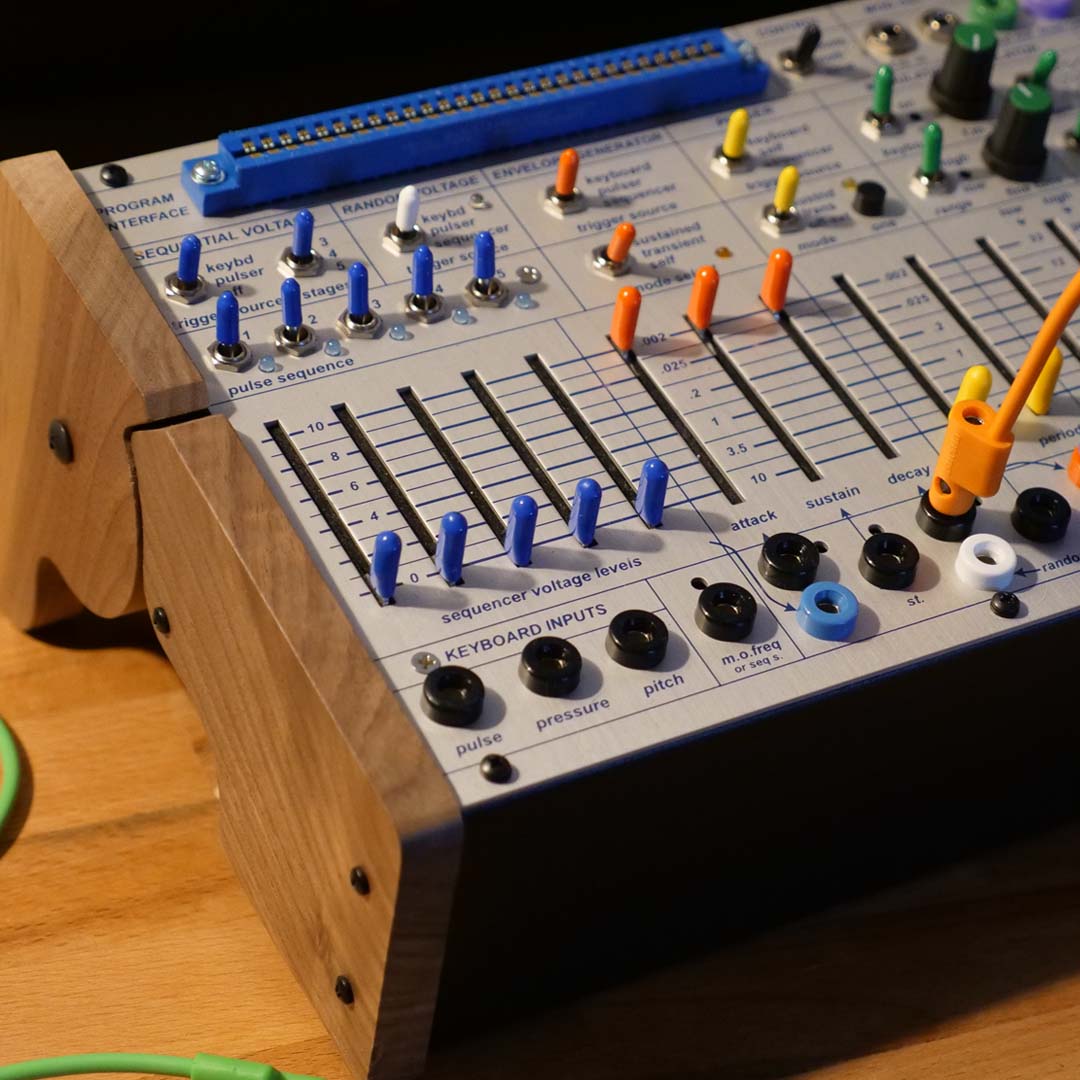
Now available for pre-order from the Synth Exchange, the Buchla Easel Command Module is a complete, standalone Buchla workflow directly descendant from the iconic Music Easel. Encapsulating many of the tools and the spirit of what is now popularly known as “West Coast” synthesis, the Easel Command combines the newly-revised 208C with a desktop enclosure and provides users plenty of options for interfacing, from MIDI and USB connectivity to Eurorack-compatible CV and Gate inputs. Its slider-based user interface and color-coded banana jacks make it stand out from any other instrument at the Synth Exchange!

An Era of Experimentation
The San Francisco Bay Area became synonymous with the concept of “experimentation” in the 1960 and ‘70s—intellectual, chemical, and musical—long before it grew into the hub of technological software innovation we know it for today. And, whether or not you know his name (yet) Donald Buchla is now considered one of the conceptual, out-of-the-box thinkers responsible for the establishment and growth of the Bay Area’s experimental reputation with his idiosyncratic electronic musical instrument designs and his pioneering conceptual approach to electronic music performance, which is now known as “West Coast” synthesis.
After graduating from the University of California, Berkeley in 1960 with a degree in physics, Buchla constructed his first voltage-controlled synthesizer in 1963 with the 100 series Electronic Music System. Commissioned by electronic music pioneers Ramon Sender and Morton Subotnick, the first Buchla synth comprised several modular boxes that generated and/or modified a “musical event.” The electronic and functional sophistication of the individual modules, alongside the ability to connect or “patch” them together in any configuration of the users choice, gave musicians and composers the power to create unique, never-before-heard sounds.
Buchla's Mission: Unrestrained Creativity in Electronic Music
Don Buchla never referred to his instruments as “synthesizers,” since the word connotes imitation of existing sounds and/or instruments. So, most of Buchla’s designs—including the Music Easel that the Easel Command Module is based on—omit a piano-style keyboard, instead of adding a unique “multi-dimensional kinesthetic input port” controller. In addition, Buchla frequently used complex waveshaping oscillators to create utterly unique timbres and tones, in lieu of the more traditional oscillator/filter combinations common to most synths.
Right away, you’ll also notice the Buchla nomenclature deviates far from standard terms—e.g., oscillator, filter, amplifier, and sequencer. Instead, Buchla named his controls and components based on his philosophical and conceptual approach to generating sounds: “Complex Waveform Generator,” “Multiple Arbitrary Function Generator,” “Source of Uncertainty,” and “Quad Dynamics Manager,” etc.
Originally part of the Buchla 200 Series Electric Music Box, Don Buchla designed the original Music Easel in 1972 to facilitate experimental synthesis and exploratory sound design, based on the 208 Store Program Sound Source responsible for the hallmark sounds of artists like Kaitlyn Aurelia Smith, Charles Cohen, Todd Barton, among others.
While you can think of the Buchla Easel Command Module as an experimental subtractive monosynth, its power lies in its potential for deviating from many now-standard synthesis concepts. To start conducting your own musical experiments and sonic explorations, preorder your Buchla Easel Command Module desktop synthesizer from the Synth Exchange, today!
SHOP BUCHLA
Related Posts

Marshall | 1959BJA Artist Signature Amp
At the 2026 Super Bowl, Billie Joe stepped onto stage in front of a new amplifier: the Marshall 1959BJA Artist Signature Amp! Designed with Billie Joe Armstrong, this new amplifier is handwired and features the “Dookie Mod” that has been the cornerstone of Green Day’s raw attack for 30 years!
View Details
Introducing | Asheville Music Tools
Adding another chapter to the rich musical history of Western North Carolina, Asheville Music Tools is a marriage of vintage audio processing techniques and modern, high quality electronics! Asheville Music Tools is the brainchild of former Moog engineer Rick “Hawker” Shaich, with assistance from John Snyder, the mastermind behind Electronic Audio Experiments. Hawker took the lessons learned from refining Moog’s pedals, and is now applying his expertise to every pedal that is pushed out of his shop!
View Details
Fender & Squier | New Baritone Guitars for Summer 2026
Three iconic Fender silhouettes are returning to the lower registers with the newest Limited Edition Fender Guitars, and the newest entry to the Squier Paranormal Series! The Fender 75th Anniversary Player II Baritone Telecaster, Fender Limited Edition Player Fusion Jaguar Baritone, and the Squier Paranormal Baritone Jazzmaster HH feature 27” scale lengths and are tuned B-to-B, to put a new spin on instantly identifiable tones, or to expand their classic circuits to suit heavier playing!
View Details