


Vintage Vibes: 1967 Gibson Byrdland Sunburst
VINTAGE VIBES: 1967 Gibson Byrdland Sunburst
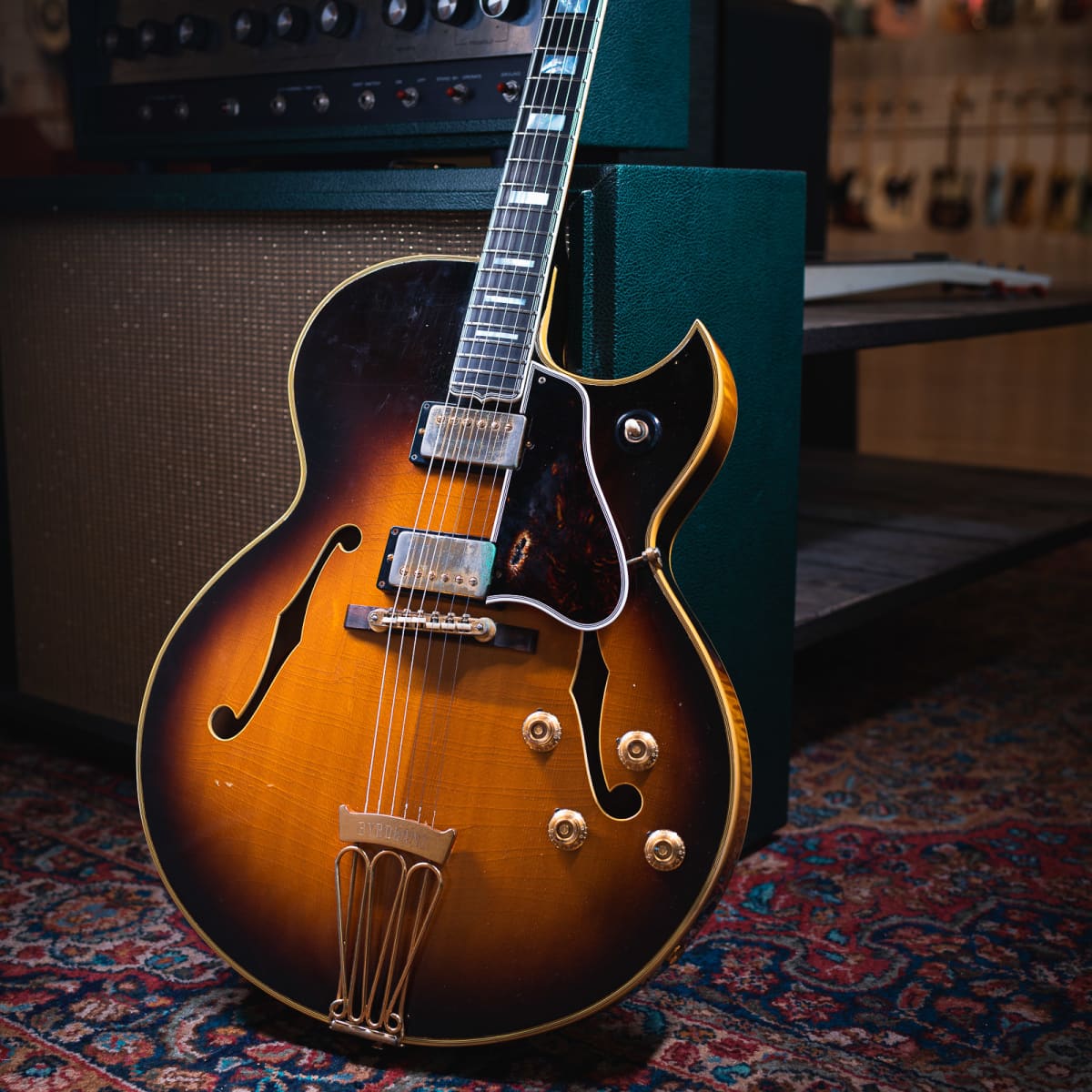
From somewhere over the rainbow comes this badass Byrdland. A portmanteau of both Billy Byrd and Hank Garland, who designed the guitar with Gibson’s Ted McCarty, the Byrdland evolved out of the L-5 CES. The three reduced the body depth, scale length, and nut width to make a lean, mean, riff-ripping machine, equally suited for jazz, country, or rock, which Nathaniel happily demonstrates.
shelby describes the '67 Gibson byrdland sunburst

It's not so long ago that we did a quick riff video with a Byrdland that came with a custom ordered Varitone switch. You can check that out in the link below. As you can see, we've now got another Byrdland. This time, a 1967.
A lot of people seem to think that the Byrdland name came from the famous jazz club in Manhattan, but that is not the case. They're not even spelled the same way anyway. It comes about from Bill Byrd and Hank Garland, two famous guitarists who worked together with Ted McCarthy, who was Gibson president at the time. Together, they came up with what we know and love today as the Gibson Byrdland.
Now, as both Garland and Byrd were jazz-influenced guitarists, they held the Gibson L5-CES in high regard. When McCarty began working with them on the Byrdland, I imagine that one of the first things they wanted to change about it was the thickness of the body in comparison to the L5. The L5 body depth is a quite chunky 3.5", whereas the Byrdland comes in at 2.25". You could argue this makes it a lot more accessible and playable. Particularly when making specific chord voicings, this means no significant stretches, allowing for faster lead line runs.
They also asked for the scale length to be shorter, twenty-three and a half inches specifically. They also made the nut wider, taking it from one and eleven-sixteenths to one and five-eighths. Now, that doesn't sound like a lot. It sounds like a minor thing, but it's actually quite noticeable when you play.
The original patent number pickups sound great, and obviously, this is a jazz-associated guitar–unless you're Ted Nugent–but it's actually a very versatile instrument, and we're going to showcase that in this video.
The guitar is all original, except for an added bone nut and a very nice refret. There is some minor off-gassing of the pickguard, which is still mostly intact, but it's a beautiful instrument. I've fallen in love with this over the past few days. It's really comfortable to play in terms of the body. The neck took some getting used to. It's quite thin, but then, once you get to grips with it, so to speak, it is actually really comfortable. I mean, unless you have slightly chunky fingers like me, but it's still really fun to play.


SHOP GIBSON
Related Posts
Yamaha Guitars | 2025 Revstar Additions
Rev up your engines—the Yamaha Revstar Standard RSS20 and RSS02T have arrived at Chicago Music Exchange, bringing performance-minded design, expanded versatility, and unmistakable style to Yamaha’s modern electric guitar lineup....
Read more
Gibson x Loog Guitars at Chicago Music Exchange
Meet the Gibson x Loog Collection—where legendary tone meets beginner-friendly design. These three-string guitars are made to empower kids to start playing right away, with simplified learning, top-tier sound, and...
Read more
Introducing | Voltage Cable Co.
Introducing Voltage Cable Co.—premium Australian-made coiled guitar cables now available at Chicago Music Exchange. Known for their iconic colorways, road-ready durability, and patented ISO-COAT® anti-corrosion technology, Voltage Cable Co. has...
Read more